
Companies in Latin America operate in a context where business conditions, headcount and organizational structures can change before a long-term real estate commitment ends. Hybrid work adds another source of uncertainty because office attendance is not evenly distributed throughout the week.
According to industry research, nearly three in four companies in Latin America operate under hybrid models, the highest proportion among the regions analyzed. When employees split their time between home and the office, demand for desks, meeting rooms and collaborative spaces can change considerably from one day to another.
This creates a practical problem for Corporate Real Estate. A company that plans its permanent space for the busiest day may carry unused capacity during the rest of the week. Planning only for average attendance creates the opposite risk: not having enough space when attendance peaks.
CRE leaders are already dealing with this issue. In a recent global survey, about one in three identified unpredictable or uneven attendance as one of their main workplace challenges. In the same study, nearly half identified flexibility of space and lease terms as the largest gap between what occupiers need and what the real estate market currently provides.
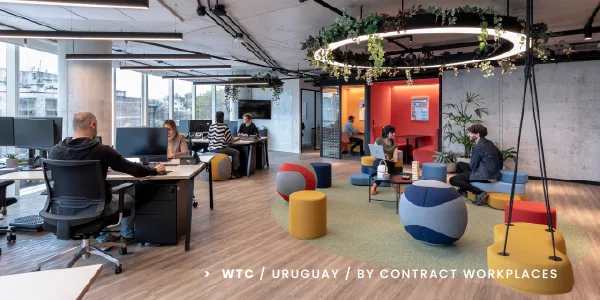
Why choose flexible office space over the conventional model
This is one of the situations where Flex Office can provide an alternative. The model combines more flexible contractual terms with ready-to-use space and, depending on the solution, integrated infrastructure, technology, maintenance and management. Companies can reduce the number of separate suppliers and processes required to open and operate an office.
The model can also reduce part of the initial investment required to fit out a conventional office. Depending on the contract, a larger share of the cost can be incorporated into recurring payments rather than committed upfront. The space can be delivered ready to operate and adapted to the organization’s requirements and brand, following a plug-and-play approach.
These characteristics can be useful for large corporations entering a new market, managing temporary requirements, expecting uncertain growth or preferring to outsource part of their workplace operation. They can also help a company add capacity without committing the entire portfolio to the same lease term or operating model.
The Latin American context adds another reason to consider flexibility. Economic volatility and regulatory changes can alter business plans while real estate commitments remain fixed. The relevant question for an occupier is therefore how much space is needed, how long that requirement is likely to last and how difficult it would be to adjust if conditions change.
A stable operation with predictable demand may still benefit from a conventional long-term office. Other requirements may be better served through shorter contracts, expansion or contraction rights, managed offices or a combination of permanent and flexible space. Flexibility can therefore be applied to the contract, the amount of space and the way the workplace is operated.
For owners, the original research also identifies an opportunity. Managed spaces may lease faster than conventional offices, helping reduce vacancy periods and potentially achieving higher rents. These claims require the supporting source to be added before publication.
The broader point is that flexible offices respond to more than contract length. They can combine space, services and operation under a model that allows companies to change capacity with fewer steps when their requirements change.
For companies in Latin America, that ability has a practical value: reducing the amount of time, capital and coordination required to expand, contract or reorganize the workplace when the business demands it.
References
1. JLL, Future of Work: Work Models in Latin America, 2024. Survey of companies across Latin America. 2. Leesman, Corporate Real Estate Leaders Poll 2026 — Mind the Gap, pp. 10–11.
3. Knotel, The Knotel Guide to the Managed Office, 2026.

