In 2011, we created the Contract Index to address the need for reliable information on office construction costs. Over the years, it has become a benchmark both for those needing to develop projects and for other market players.
15 years later, we know that making decisions about workspaces in the region requires going beyond construction costs. Rental rates, space availability, and new workplace dynamics demand a broader, more unified perspective.
However, in many organizations, information remains fragmented: Finance measures investment, Real Estate tracks the market, Construction handles execution, and Human Resources observes how people’s needs evolve. When data moves through separate channels, the process loses agility.
That is why we developed LATAM Corporate Space: a corporate real estate report that complements the Contract Index by integrating key regional market variables into a single place.
“In 30 years of listening to the pulse of the industry, we learned something very practical: the challenge companies face isn’t a lack of data, but the ability to connect it. If each department reads from its own sheet music, the orchestra loses its rhythm, no matter how valuable the data is. We needed a tool that would bring all that intelligence to the same table,”— Herman Faigenbaum, CEO of Contract Workplaces.

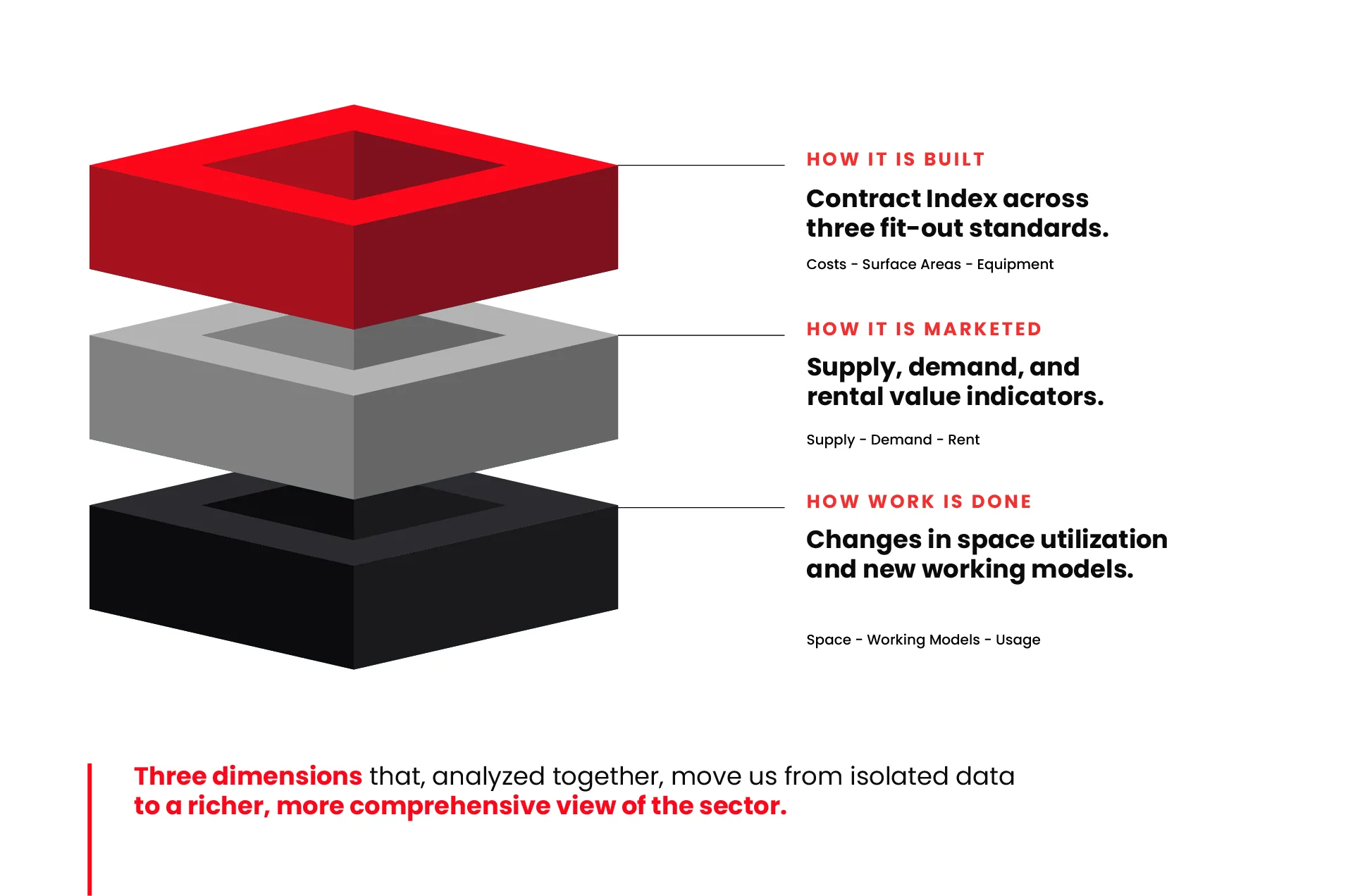
The report provides a snapshot of the industry across three core pillars
· 📐 Office construction costs (how it’s built): The Contract Index structured across three corporate fit-out standards (Functional, Performance, and Prime) based on real projects in the region.
· 📊 The pulse of the real estate market (how the market operates): Supply, demand, and rental rate indicators for Class A office spaces to understand sector activity.
· 💡 Workplace trends and flex office (how people work): Changes in space utilization and new working models to identify opportunities and adapt early.
Planning on the same wavelength
A corporate space strategy involves multiple perspectives and departments within an organization. Having unified information facilitates internal dialogue within the company and enables business leaders to evaluate alternatives by cross-referencing investment, market dynamics, and space design.
That is the purpose of LATAM Corporate Space: integrating key data so that all teams can analyze scenarios clearly and move forward on the same wavelength.
Read the report and get ahead of your next workplace strategy.