From modern office design to technology and HR strategies, what are companies worldwide doing to bring their teams together again in the workspace?
“How do I make my employees want to come back to the office?” This is a question we frequently encounter among our clients. And the answer involves many variables.
While it has been proven that remote work was successful in most cases, the physical office serves countless functions that can hardly be replicated in a virtual environment. In addition to fostering interaction among people, offices are a powerful tool for cultivating organizational culture, attracting and retaining talent, and creating an experience for employees and clients that aligns with the company’s stated values (such as sustainability, well-being, innovation, etc.).
However, to attract workers back to the office, communicating isolated policies and directives is not enough. Decisions must be made and changes activated that integrate the three most critical pillars: space, people, and technology.
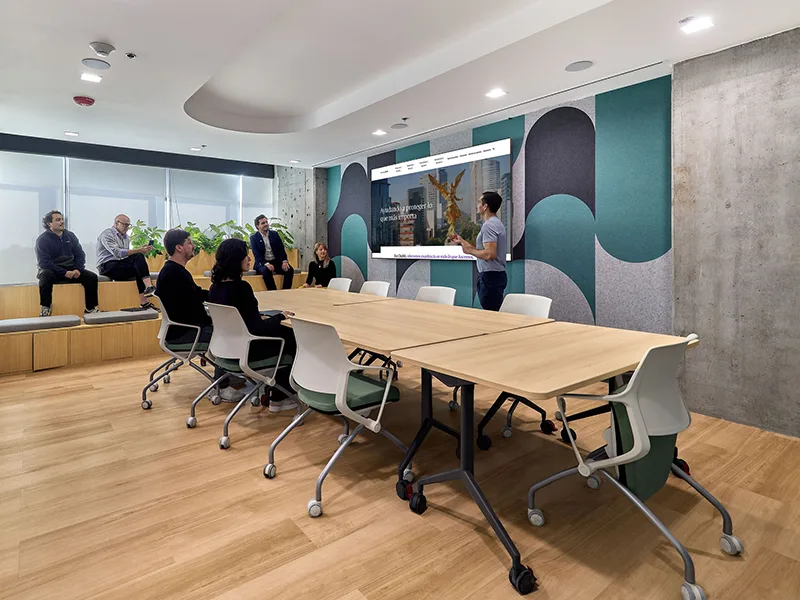
Latest Trends in Modern Office Interior Design and Amenities That Make a Difference
In this regard, four archetypes have been identified for new workspaces. These respond to the different needs expressed by companies, redefining the role of offices within each organization and, why not, within the community.
The 4 Archetypes of the Modern Office: Innovation and Design to Attract Talent
1. The Matrix Model: Technologically Integrated Office Design
This is an environment that blends the physical and the digital, facilitating collaboration across time and distance between people on-site and those working remotely.
It offers a range of technical and specialized spaces, such as broadcast studios or presentation suites, providing seamless connectivity to the ecosystem for people spending time in the office. There is also a constant process of experimentation and piloting to achieve digital equity for all participants in hybrid meetings.
2. The Social Hub: Experiential Office Design
Heavily oriented toward face-to-face social interaction and collaboration, this model focuses on creating an attractive “destination of choice” for employees who now have more freedom regarding where they work.
Employees who spend at least part of their week working remotely expect a “super-experience” in terms of design, atmosphere, and human connection when they show up at the workplace.
Therefore, food and beverage are integral to a remodeled modern office, alongside client project rooms, collaborative workspaces, game zones, lounges, restaurants, and other amenities designed to enhance social activity.
3. The Shared Experience: Corporate Architecture Integrated into the Urban Space
This workplace enjoys a more permeable relationship with the local district and communities, as well as with the physical features of the urban or rural setting that provides its context. This is expressed through public lobbies, observation decks, art galleries, walking paths, food markets, and other public services carefully woven into the overall site strategy.
As part of caring for the environment, this model emphasizes sustainability, carbon reduction, and the promotion of diversity, equity, and inclusion (DEI).
There is also a clear trend here of “bringing the outdoors in.” This can be done literally by integrating the surrounding landscape into the office, adding coworking spaces to the building plan, or bringing in external catalysts—such as incorporating emerging startups into shared incubators to support corporate innovation.
4. The Development Space: Workspace Design Focused on Innovation
This model combines a focus on learning, mentorship, and creativity with a commitment to improving the mental well-being of all employees.
Innovation and learning are harder to replicate online. Returning to the office provides an opportunity to reconfigure the workspace to meet fundamental needs, offering an environment tailored to provide the right experiences and the proper level of support.
This approach manifests in environments as diverse as learning suites, rapid prototyping workshops, nap pods, prayer rooms, music rooms, editing suites, quiet spaces, social zones, and access to outdoor working areas. The goal is to allow both individuals and the organization to thrive.
In the process of applying these typologies to our clients’ office designs, the result is rarely a pure model, but rather a blend of them.
Finding which elements of these archetypes apply to each company’s business model, purpose, and objectives is a major challenge. It requires rethinking the why, the what for, and the how of the work experience. This implies a necessary review and analysis of where each company stands today and where it wants to go, understanding space as a catalyst for that change.
In this process, modern offices play a fundamental role, as they are the environment that facilitates interaction, innovation, and the constant evolution of the organization.

