Agile working is not a novelty. Large companies related with the technology sector, such as Facebook and Google, have been implementing it for several years. It is a strategy that is not limited to flexible work or teleworking, but it is also focused on achieving goals in an efficient way with maximum flexibility and minimum restrictions, oriented towards results and innovation, and people-centred. The workspace of an agile organisation should support this strategy and offer an environment suitable to adapt quickly to the changing needs of both collaborators and the organisation. But since the purpose of the office is to optimise productivity to achieve better results, each company must find the formula that best fits its objectives. In today’s changing world, agile working is a resource that no organisation can afford to ignore.
Today, the pace of the change driven both by the advancing technology as well as by cultural and economic transformations is getting faster than ever. Even the nature of work itself is changing and will keep on changing, especially with the development of automation processes and AI, since according to current estimates, 75% of today’s office work is based on data processing.
In this unpredictable and volatile context, companies need to continuously evolve to remain competitive, and many have already adopted useful strategies to be able to rapidly reshape their own businesses.
However, the concept of agile working is not always well understood. The terms “agile” and “flexible” are frequently used interchangeably, even though they have different meanings; performing the same work in the same manner, but from different locations is not agile, it is merely flexible work.
Agile working is a way of working that makes the most out of new technologies and new work environments. People can perform their tasks at any moment and from any place, but they also do their job autonomously, focusing on performance and results.
To take advantage of the opportunities created by implementing this strategy, the key lies in adopting an agile organisational culture, getting employees to commit and empower them in a relationship based on trust and responsibility. All the while, without forgetting that the workspace should offer an environment that supports this practice and that can be quickly adapted to the changing needs of both the collaborators and the organisation.
What is Agile Working?
Based on what is known as the “Agile Manifesto”—which came into being in the IT industry as a software development method—this way of working can be applied at any type of organisations.
The concept of agile working is based on the idea that work is an activity we do, not a place where we go. It favours flexibility by allowing people to work in the way that best fits their own needs without the traditional limitations regarding where, how and when tasks need to be completed. Collaborator autonomy and empowerment are key elements in this strategy.
To this end, we need to use the available technology along with a range of IT resources which allow us to work in new and different ways, to better satisfy the needs of our clients, reduce costs, increase productivity and improve sustainability. By eliminating all these superfluous barriers, agile working allows us to work more efficiently.
But this can only be achieved with high levels of trust and a culture based on performance and accomplishment of goals. This involves having new management skills which allow teams to work more effectively, communicate better and maintain high levels of commitment and performance.
Unlike flexible work, agile working is mainly focused on the benefit of the business. Work processes and practices are based more on the tasks than on how, when or where they are completed. This means that collaborators get to work wherever they think they will be more efficient: at the office, from home, at a hot desk, at the clients’ office or from any other place that helps them maximize their needs in order to accomplish their goals.
Some of the factors that have favoured an evolution towards agile working are the following:
- Technology
New technologies have created multiple ways of connecting with colleagues and clients, of collaborating and sharing knowledge and ideas quickly and effectively anywhere and anytime.
- Increasing demand for a balance between work and private life
The new generations that are joining the labour market attach great importance to the balance between work and private life. They want a challenging job, but they also prioritise having the necessary flexibility to be able to complete it in their own terms.
- Cost and profitability
In large cities, space is an increasingly scarcer and more expensive commodity. The structure of the traditional office is costly: it has been proven that it has a low occupancy rate and that many desks remain vacant during most of the working day. Agile working can help to reduce the necessary space and thus optimize operations and improve profitability.
- Sustainability
In cities collapsed by car traffic, avoiding daily commutes saves transportation times and simultaneously saves energy in transportation and reduces environmental pollution.
| Some Principles of the Agile Manifesto |
| The highest priority is to satisfy the customer. |
| We need to harness change. |
| We need to build projects around motivated individuals. |
| The most efficient and effective method of conveying information is face-to-face conversation. |
| Agile processes promote sustainable development. |
| Continuous attention to technical excellence and good design enhances agility. |
| Simplicity is essential. |
| We need to work with self-organizing teams. |
| We need to reflect on how to become more effective. |
Source: https://agilemanifesto.org/principles.html
The Benefits and Limits of Agile Working
Implementing an agile working strategy can benefit companies in several aspects that range from a lower employee turnover to higher productivity and lower operating costs. These benefits, in turn, can result in a more solid organisational culture and in better results.
- Increased productivity and efficiency: By giving more power of decision, flexibility and autonomy to work teams, responsiveness, efficacy and productivity increase.
- More innovation: Teams that can make decisions on their own working conditions are usually more motivated and more creative.
- Higher commitment: given that employees have more autonomy, trust and power of decision, they feel more responsible, which results in a higher level of commitment.
- Higher job satisfaction: having a more balanced work-private life relation, along with the empowerment and autonomy needed to accomplish pre-established goals, creates higher job satisfaction.
- Greater talent retention: working conditions offered through agile working helps retain talented employees longer.
- Lower operational costs: Agile workspaces make a more efficient use of the space available. Since there are practically no appointed workstations, the use of workspaces is optimised, and this results in lower operational costs.
- Guaranteed business continuity: the possibility of working remotely reduces interruptions due to bad weather, seasonal illnesses, traffic, potential natural disasters, etc. Thus, normal business activity is not compromised.
However, we should not underestimate the limitations of this strategy. Many companies are faced with the reality that the biggest obstacle when it comes to implementing agile working is organisational culture. It is not enough to equip offices with state-of-the-art technology or invest in costly renovations if there is no culture to provide autonomy and empowerment to collaborators, to encourage individual responsibility and to create bonds of trust. Only after a solid agile culture is built can the benefits of agile working truly be reaped. And this change also requires the development of new leadership skills on the part of the management.
Characteristics of an Agile Workplace
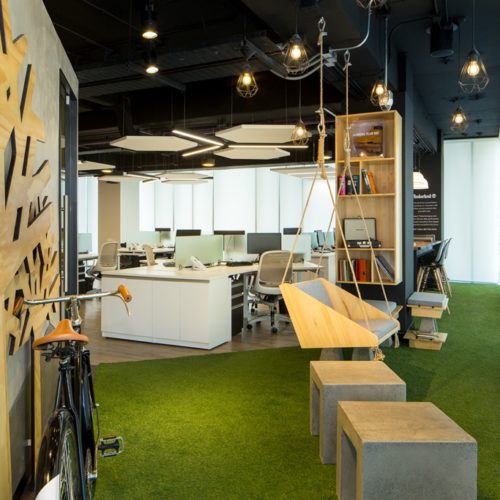
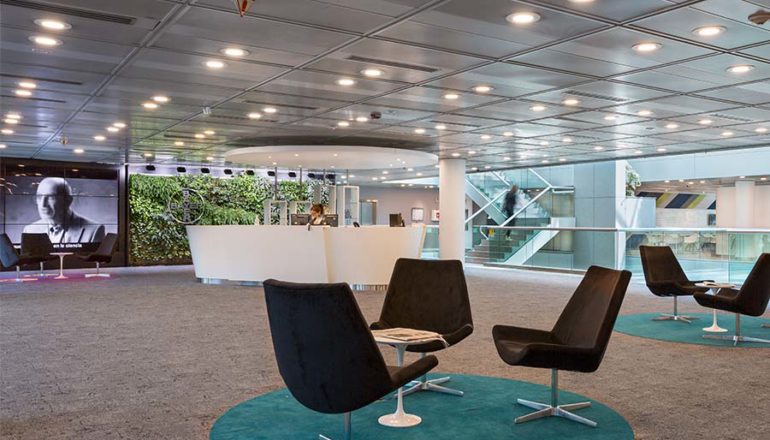
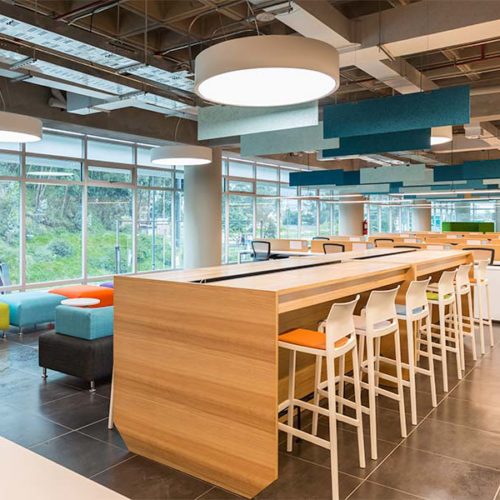
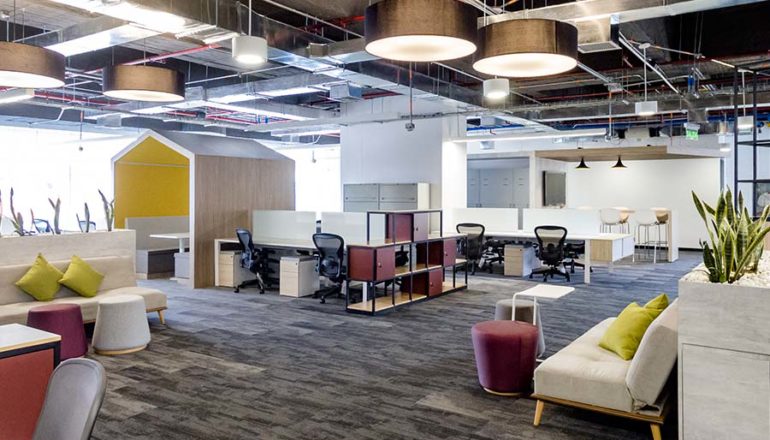
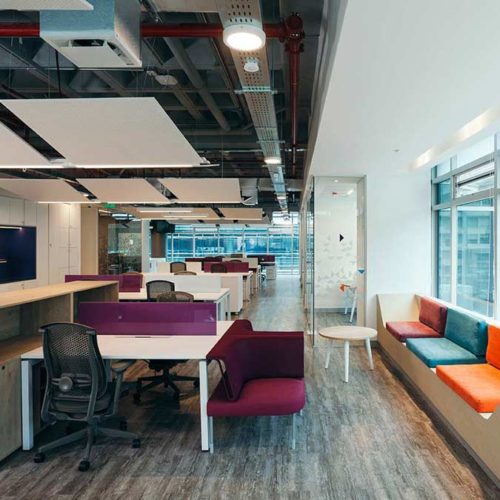
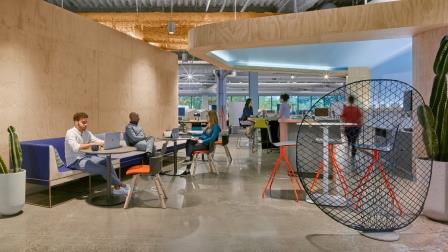
In order to accomplish the goals set by agile working, the design of the physical space is a crucial element. The workspace should bolster and support the needs for flexibility, efficiency, productivity and collaboration, by providing adequate spaces to hold all kinds of activities: quiet areas for individual work, as well as open and shared spaces for the development of collaborative projects. Furthermore, the design of the work environment should allow the resetting of spaces based on the different needs of collaborators throughout the day.
Traditionally, the focus to organize the workplace was to appoint a desk or office to each person and group people by department. But this type of setting reflects hierarchy and status, not role and function. Even more, this distribution is pointless since most people no longer spend their days behind a desk performing repetitive tasks. Collaborative work is on the rise, and people are spending more time working with colleagues or clients. This suggests that the spaces demanded by people to perform different kinds of jobs are changing. Agile workplaces focus on an efficient use of space and offer a wide array of options that provide the necessary resources, when and how they are needed.
- Layout: an open plan setting favours communication and collaboration, while it allows for an optimal use of space.
- Breakout areas: it is all about offering multifunctional spaces where people can chat, collaborate, relax, eat and organize meetings with their work teams.
- Quiet areas: agile workplaces do not usually have private offices, which is why quiet areas allow employees to perform tasks that require concentration without distractions.
- Shared desks: they are ideal for employees who are intermittently at the office. These areas are especially designed to complete tasks quickly.
- Technological equipment: it plays a key role in the agile working strategy, as it makes it possible for employees to move around both inside and outside the office. It is not about connecting desks, it is about connecting people.
- IT resources: IT resources used to implement and manage an agile working strategy can vary, from Cloud services, video communication platforms and free resources such as Skype and FaceTime for daily exchanges, to electronic access cards and virtual private networks, to name a few.
Conclusions
Agile working is a new way of working that is based on giving autonomy, trust and flexibility to the people, along with the technology and the tools needed to complete their tasks in the way they consider most effective and suitable. This means that collaborators get to work in an office, from home, at a hot desk, at the clients’ office or from any other place that helps them maximize their chances of accomplishing their goals, replacing a culture based on office jobs for result management.
An agile organisation will require a workspace suitable to sustain and support the needs for flexibility, efficiency, productivity and collaboration by providing adequate spaces to complete all kinds of activities.
However, this strategy is not a single solution that works for everybody. In today’s quickly-evolving labour market, each company needs to find a formula that best fits its goals. In today’s changing world, agile working is a resource that no organisation can afford to ignore.
SOURCE: FM & WORKPLACES